
I don’t know about you, but I’ve always thought crocheted footwear looked intimidating. All those tiny motifs, the attachment to actual soles, the worry about whether they’d fall apart after one wear. But here’s the thing. These gladiator-style sandals are basically just pretty squares and straps attached to flip flop soles. Suddenly not so scary, right?
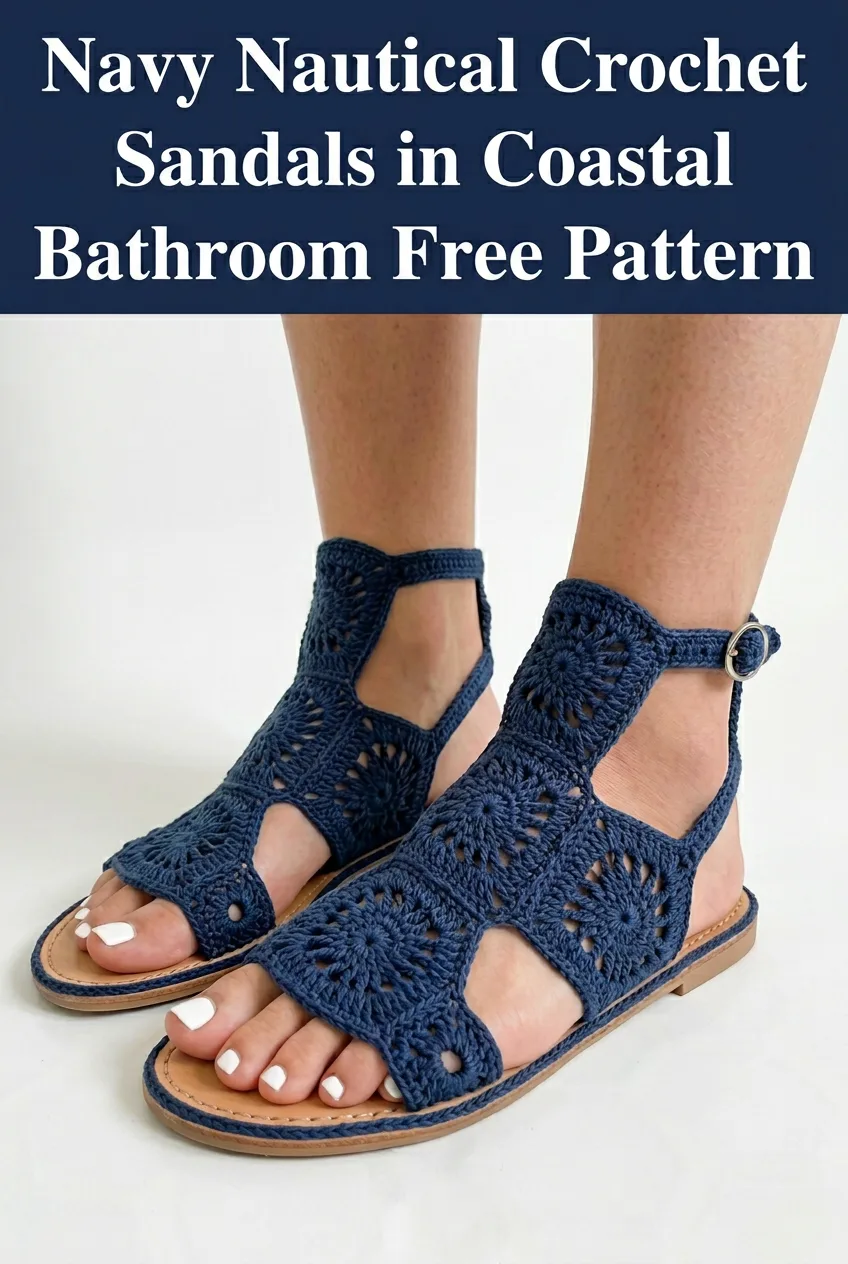
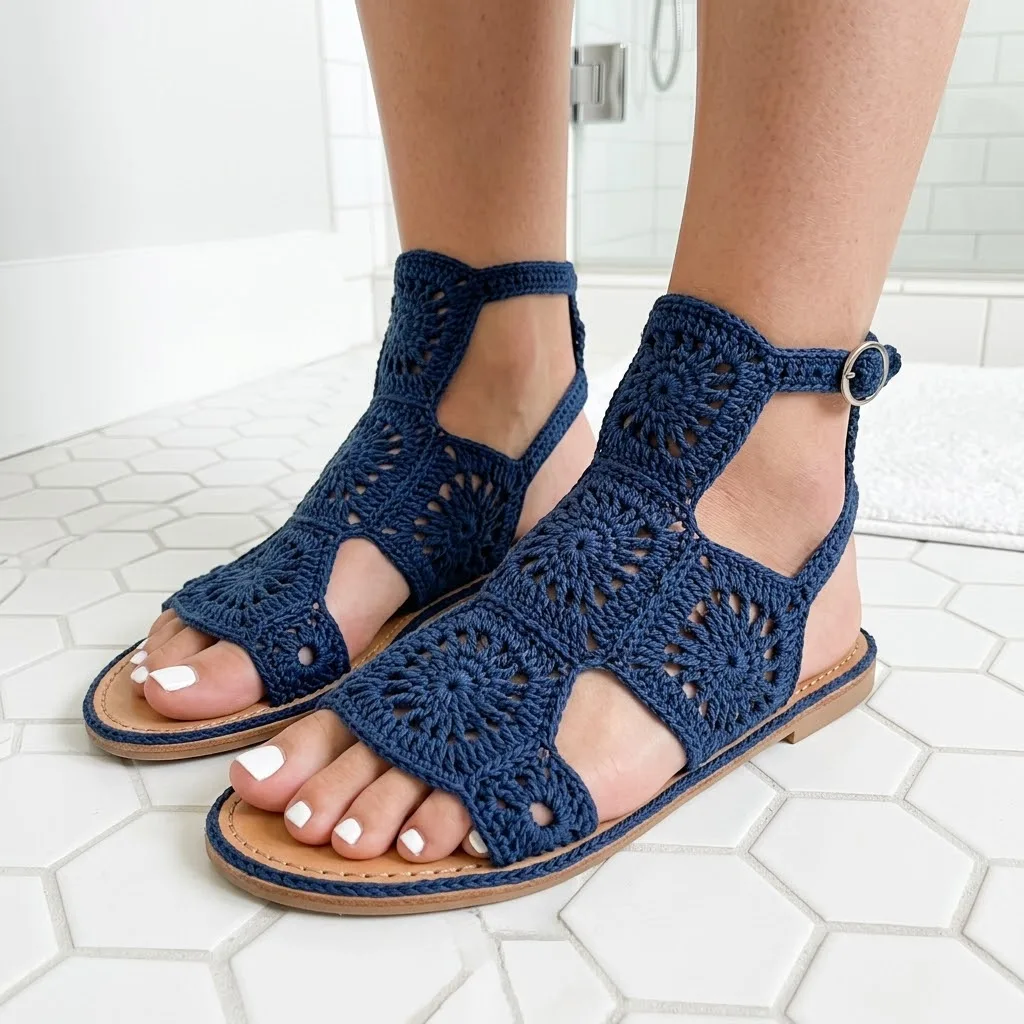
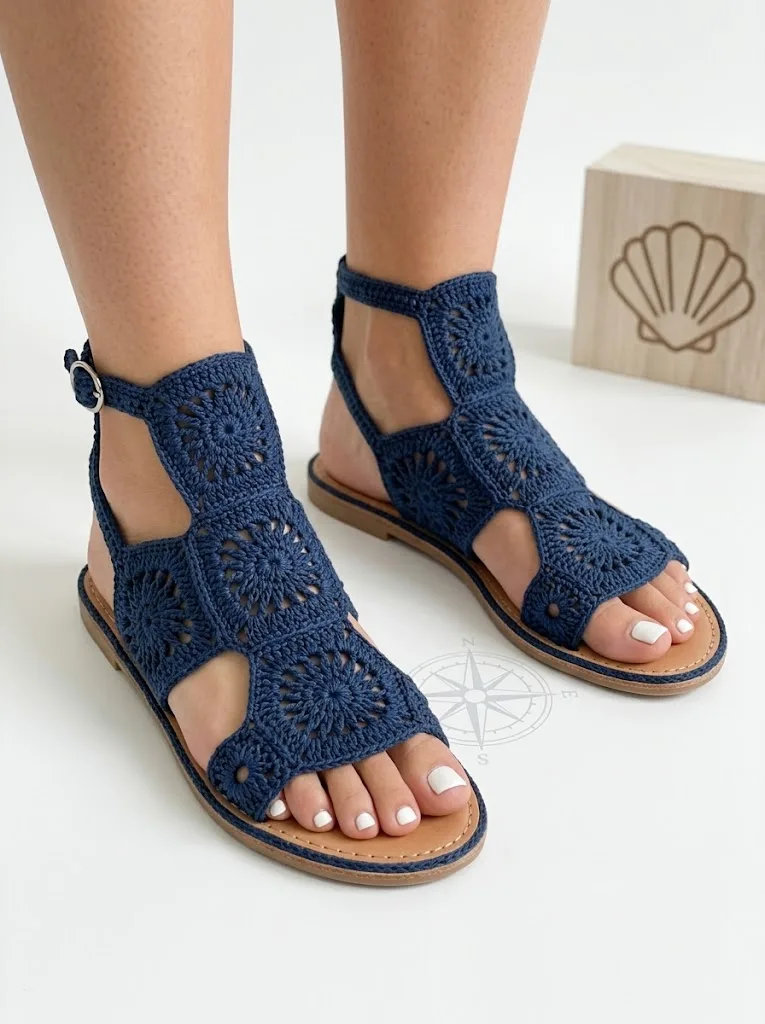
These navy crochet sandals combine the look of expensive boutique footwear with the satisfaction of making something truly wearable with your own two hands. The lacy circular motifs give them that high-end boho vibe, while the sturdy construction means you’ll actually want to wear them out of the house.
Why You’ll Love This Crochet Sandal Pattern
Let me tell you why this project jumped to the top of my summer crochet list. First, the color. This deep navy blue works with everything from white linen pants to your favorite sundress. It’s sophisticated without being boring.
Second, the construction is surprisingly logical once you break it down. You’re making individual granny square-style motifs, joining them strategically, then attaching the whole thing to a simple flip flop base. No mysterious shoemaking skills required.
The lace-like openwork keeps your feet cool in warm weather, and the ankle strap with its little metal buckle adds both security and style. These aren’t slippers pretending to be shoes. They’re actual sandals you can wear to brunch, the farmers market, or a beach boardwalk.
Skill Level
Intermediate. If you can make a granny square and work basic stitches in the round, you have the skills for this crochet tutorial. The joining and finishing require patience, but nothing here is technically difficult.
Beginners, don’t run away yet. If you’ve completed a few projects and feel comfortable reading patterns, this is a great stretch project. I’ll walk you through every step.
Materials Needed for Your Crochet Sandals
Yarn
Cotton yarn in DK weight (size 3) works best for this project. I recommend 100% mercerized cotton for its strength, slight sheen, and ability to hold up to foot traffic. You’ll need approximately:
Suggested yarns: Drops Muskat, Scheepjes Catona, or Lion Brand 24/7 Cotton
Cotton holds its shape better than acrylic for footwear, and it won’t get slippery or stretchy with wear. Trust me on this one.
Tools
Optional But Helpful
Gauge
One completed circular motif measures approximately 2.5 inches (6.5cm) in diameter.
4 double crochet stitches = 1 inch in pattern
Gauge matters here because the motifs need to fit together properly and cover the foot without gaps. Make one test motif before diving in.
Abbreviations and Stitch Definitions
Let me break down every stitch you’ll use in this pattern. Even if you know these, a quick refresher never hurts.
ch = chain: Wrap yarn over hook, pull through loop on hook. The foundation of almost everything in crochet.
sl st = slip stitch: Insert hook, yarn over, pull through both the stitch and the loop on your hook in one motion. Used for joining and moving across stitches invisibly.
sc = single crochet: Insert hook, yarn over and pull up a loop (2 loops on hook), yarn over and pull through both loops. A short, tight stitch.
dc = double crochet: Yarn over, insert hook, yarn over and pull up a loop (3 loops on hook), yarn over and pull through 2 loops, yarn over and pull through remaining 2 loops. Taller than single crochet, creates that lovely drape.
tr = treble crochet: Yarn over twice, insert hook, yarn over and pull up a loop (4 loops on hook), [yarn over and pull through 2 loops] three times. Even taller, used for the lacy openwork sections.
ch-sp = chain space: The gap created by a chain in a previous row. You’ll work into this space, not into individual chains.
cluster = multiple stitches worked into same space and joined at the top: Creates those beautiful petal-like shapes you see in the motifs.
Pattern Notes Before You Begin
Read this section. It’ll save you frustration later.
1. Each sandal uses 4-6 circular motifs depending on your foot length
2. Motifs are joined as you go on the final round
3. The T-strap and ankle strap are worked directly from the motif assembly
4. Right and left sandals are mirror images, so pay attention to which side the buckle strap goes
A word about flip flop bases: Remove the rubber thong straps completely. You want just the flat sole. Some crafters prefer to crochet around the entire sole edge first, then attach the upper. I’ll give you both options.
The Pattern
Circular Motif (Make 8-12 Total)
These gorgeous wheel-like motifs form the main body of your sandal upper. The openwork creates that expensive lace look.
Round 1: Create a magic ring. Ch 3 (counts as first dc throughout), work 11 dc into ring. Sl st to top of ch-3 to join. Pull ring closed. (12 dc)
Round 2: Ch 3, dc in same st. 2 dc in each st around. Sl st to join. (24 dc)
Round 3: Ch 4 (counts as dc plus ch-1), skip next st, *dc in next st, ch 1, skip 1 st.* Repeat from * around. Sl st to 3rd ch of beginning ch-4 to join. (12 dc, 12 ch-1 spaces)
Round 4: Sl st into first ch-sp. Ch 3, 2 dc in same sp, ch 2. *3 dc in next ch-sp, ch 2.* Repeat from * around. Sl st to join. (12 clusters of 3 dc, 12 ch-2 spaces)
Round 5: Sl st to center dc of first cluster. Ch 1, sc in same st. *Ch 5, skip ch-2 sp and next cluster, sc in center dc of following cluster.* Repeat from * around, ending with ch 5, sl st to first sc. (6 sc, 6 ch-5 loops)
Round 6: Sl st into first ch-5 sp. Ch 3, 4 dc in same sp, ch 2, 5 dc in same sp. *Ch 1, (5 dc, ch 2, 5 dc) in next ch-5 sp.* Repeat from * around. Ch 1, sl st to join. (6 shell groups)
This creates the lovely sunburst pattern visible in the sandals. The center is dense, and the edges have that beautiful petal effect.
Fasten off, leaving an 8-inch tail for joining.
Joining Motifs
Lay out your motifs to plan placement. For a size 7-8 sandal, you’ll need:
Join-as-you-go method: On the final round of subsequent motifs, replace the ch-2 at shell corners with: ch 1, sl st to corresponding ch-2 sp of previous motif, ch 1. This creates a flat, secure join.
Alternatively, whip stitch motifs together using your yarn tail after all motifs are complete.
T-Strap Section
The vertical strap runs from the toe motifs up to the ankle.
Row 1: Join yarn to the center top of your toe motif assembly. Ch 1, work 8 sc evenly across the joining point. Turn. (8 sc)
Rows 2-15: Ch 1, sc in each st across. Turn. (8 sc)
Adjust row count for your foot length. The strap should reach from toe motifs to just above your ankle bone.
Fasten off.
Ankle Band
Row 1: Join yarn at side edge of top motif. Ch 1, work 30-40 sc evenly around the ankle opening, incorporating the top of the T-strap. Join with sl st to first sc. (30-40 sc)
Rows 2-4: Ch 1, sc in each st around. Join. (30-40 sc)
For the buckle strap extension (one side only):
Row 5: Working on back ankle section only, ch 1, sc in next 8 sts. Turn.
Rows 6-12: Ch 1, sc in each st across. Turn. (8 sc)
Row 13 (buttonhole row): Ch 1, sc in 2 sts, ch 4, skip 4 sts, sc in last 2 sts. (4 sc, ch-4 sp)
Row 14: Ch 1, sc in 2 sts, 4 sc in ch-4 sp, sc in last 2 sts. (8 sc)
Fasten off and weave in end.
Attaching to Flip Flop Sole
This is where your sandals become real footwear.
Method 1: Crochet Edging
Work a round of sc around the entire flip flop sole edge, punching through the rubber with your hook every quarter inch or so. This creates an anchor row.
Then, using sl st or sc, attach your motif assembly to this edging, matching center toe motifs to center front of sole.
Method 2: Glue and Stitch
Apply fabric glue around the sole edge. Press crocheted upper firmly against glue. Let dry completely. Then add reinforcement stitches through the upper and around the sole edge where possible.
I prefer Method 1 for durability, but Method 2 works well if your flip flops have thick soles that resist a hook.
Finishing the Sole Edge
Work a final round of sc or sl st around the entire sole edge, encasing the raw flip flop edge in yarn. This gives that polished, professional look visible in the finished sandals.
Attach buckle to strap by folding the strap end through the buckle bar and stitching securely.
Tips for Success
Block your motifs before joining. Wet blocking cotton helps even out stitches and makes joining much easier.
Try on frequently during assembly. Feet are all different shapes. Adjust motif placement as needed.
Reinforce high-stress areas with extra stitches. The toe section and ankle strap attachment points see the most wear.
Consider adding a fabric liner to the sole for extra comfort. Trace your flip flop, cut from soft cotton fabric, and glue inside the sole cup.
Sizing Adjustments
For smaller feet (5-6): Use fewer motifs or slightly smaller hook.
For larger feet (9-10): Add an extra motif to the midfoot section and lengthen the T-strap by 4-6 rows.
Width adjustments: The lace motifs have natural give, but for very wide feet, space motifs slightly further apart during joining.
Caring for Your Crochet Sandals
Hand wash in cool water with mild soap. Reshape and air dry away from direct heat or sunlight (which can fade that gorgeous navy).
For quick freshening, spot clean with a damp cloth and let dry completely before wearing again.
Store stuffed with tissue paper to help motifs keep their shape between wearings.
Make It Your Own
This crochet sandal pattern is wonderfully adaptable. Try these variations:
Color options: Cream for a beach wedding, rust for fall, or variegated cotton for a playful look
Embellishments: Add small wooden beads to the ch-5 loops in Round 5, or weave thin leather cord through the openwork
Sole alternatives: Espadrille rope soles, cork platforms, or even sturdy leather soles from a shoe repair shop
I’m so excited for you to try this step by step crochet tutorial and create your own gorgeous summer footwear. When you finish your sandals, I’d love to see them! Tag me on Instagram or share in our Facebook group so I can celebrate with you.
Save this crochet pattern to your Pinterest boards so you can find it when you’re ready to start. And please drop a comment below if you make these beauties. I read every single one and love hearing how your projects turn out!
You Might Also Like
- Buttercream Yellow Dragon Amigurumi Plush Free Crochet Pattern
- Blush Pink Romantic Lace Bucket Bag Free Crochet Pattern
- Sage Green Botanical Shell Purse Free Crochet Pattern
- Lavender Purple Dreamy Lace Maxi Skirt Free Crochet Pattern