I’ve been looking for the perfect summer crochet jewelry project for ages, and this lavender charm bracelet completely stole my heart. I rounded up all my favorite micro crochet techniques into one stunning piece that looks way more complicated than it actually is. This is my new favorite pattern for anyone who wants to try miniature crochet for the first time or create a truly show-stopping handmade gift.
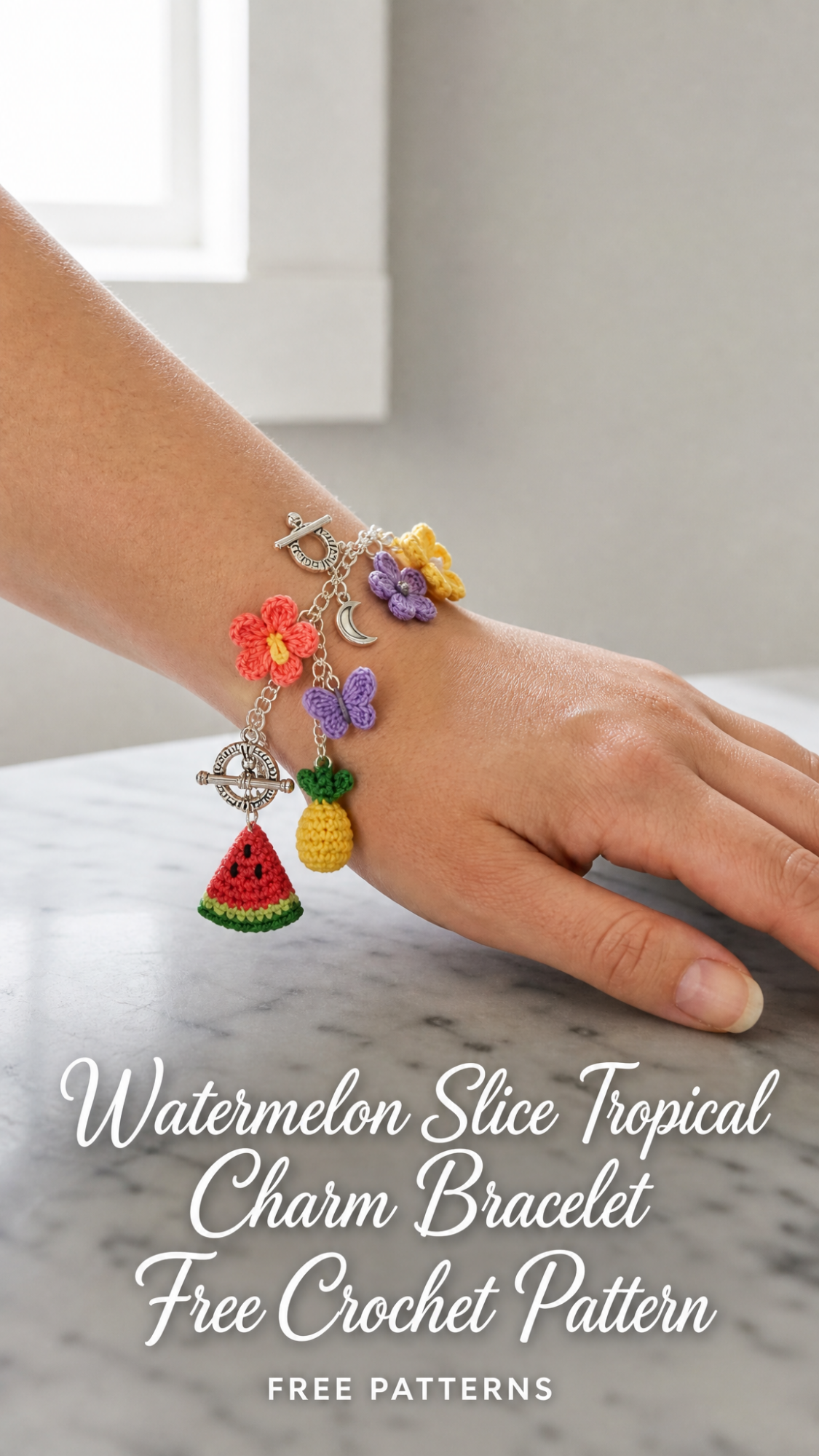
Looking at this bracelet, you might think it requires years of experience and specialized training. I promise you it doesn’t. Yes, the tiny lavender sprigs and delicate butterflies look incredibly intricate. But when you break each element down into individual steps, you’ll see that every charm uses basic stitches you probably already know. The magic happens when you combine them all together on a simple silver chain.
Why This Charm Bracelet Pattern Works So Well
This pattern creates a garden-themed charm bracelet featuring multiple crocheted elements attached to a silver toggle chain. The design includes lavender flower sprigs in two shades of purple, tiny white daisies with yellow centers, miniature butterflies, and an adorable lavender sachet charm. Amethyst beads and a silver moon charm add sparkle and dimension between the crocheted pieces.
The finished bracelet measures approximately 7 to 8 inches around, fitting most adult wrists comfortably. Each crocheted charm ranges from about half an inch to one inch in size, making this a true micro crochet project.
Skill level: Intermediate. You should be comfortable with basic stitches and working in very small scales. If you’ve never tried micro crochet before, this pattern includes enough guidance to help you succeed.
Materials You Will Need
Yarn:
Hook:
Jewelry Supplies:
Tools:
Abbreviations and Stitch Definitions
Before we dive in, let me walk you through every stitch abbreviation you’ll encounter. Even if you know these by heart, micro crochet sometimes behaves differently than regular yarn work.
ch = chain. Wrap yarn over hook and pull through the loop on your hook. This creates one chain stitch.
sl st = slip stitch. Insert hook into stitch, yarn over, pull through both loops on hook. Used for joining and moving across stitches without adding height.
sc = single crochet. Insert hook into stitch, yarn over and pull up a loop (two loops on hook), yarn over and pull through both loops. Creates a short, dense stitch.
hdc = half double crochet. Yarn over, insert hook into stitch, yarn over and pull up a loop (three loops on hook), yarn over and pull through all three loops. Slightly taller than single crochet.
dc = double crochet. Yarn over, insert hook into stitch, yarn over and pull up a loop (three loops on hook), yarn over and pull through two loops, yarn over and pull through remaining two loops. Creates a taller stitch with nice drape.
inc = increase. Work two stitches into the same stitch to add width.
magic ring = An adjustable starting loop that closes completely. Wrap yarn around finger, insert hook, pull up loop, chain one, then work stitches into the ring. Pull tail to close the center hole.
Pattern Notes Before You Begin
Working with crochet thread requires patience and good lighting. I recommend sitting near a window during daylight hours or using a bright task lamp. Your eyes will thank you.
Tension matters enormously in micro crochet. You want your stitches tight enough that the fabric holds its shape but not so tight that you can’t insert your hook. If your charms look floppy, try going down a hook size. If they feel stiff as a board and your hands hurt, go up a size.
Stiffening your finished charms helps them hold their shape on the bracelet. You can use commercial fabric stiffener, diluted white glue (one part glue to two parts water), or even clear nail polish dabbed on the back. Let them dry completely before attaching to the chain.
Lavender Sprig Pattern (Make 3 to 4)
The lavender flowers are the stars of this bracelet. Each sprig consists of a green stem with purple "buds" worked around it. You’ll make some in light purple and some in dark purple for visual depth.
Stem:
With sage green thread,
Row 1: Ch 15. Starting in second ch from hook, sl st in each ch across. (14 sl sts)
Fasten off, leaving a 4 inch tail for attaching to the chain.
Flower Buds:
With purple thread (light or dark), leaving a 3 inch tail,
Round 1: Join thread to the top of the stem with a sl st. Working around the stem, *ch 3, sl st in same space* 3 times. Move down approximately 2 stitches on the stem.
Round 2: *Ch 3, sl st in stem* 4 times. Move down 2 stitches.
Round 3: *Ch 3, sl st in stem* 4 times. Move down 2 stitches.
Round 4: *Ch 3, sl st in stem* 3 times.
Fasten off. Weave in the end by threading it down through the stem center.
The chain-3 loops create the textured, bumpy appearance of lavender buds. Don’t worry if they look messy at first. The irregular texture actually makes them more realistic.
Daisy Pattern (Make 2)
These cheerful little daisies add brightness and contrast to the purple palette.
Center:
With yellow thread,
Round 1: Make a magic ring. Ch 1, work 6 sc into the ring. Pull tail to close. Sl st to first sc to join. (6 sc)
Do not fasten off. Change to white thread.
Petals:
Round 2: *Ch 4, sl st in second ch from hook, sl st in next ch, sl st in next ch, sl st in next sc of center* Repeat around. (6 petals)
Fasten off, leaving a 4 inch tail.
The petals should fan out naturally from the yellow center. If they bunch up, gently spread them with your fingers while the thread is still pliable.
Butterfly Pattern (Make 2)
These tiny butterflies add whimsy and movement to the bracelet. They work up in just a few minutes once you get the hang of the pattern.
Body:
With light purple thread,
Row 1: Ch 6. Starting in second ch from hook, sl st, sc, hdc, sc, sl st. (5 sts)
Do not fasten off.
Upper Wings (worked on each side of body):
Ch 5, dc in third ch from hook, dc in next ch, hdc in last ch, sl st to top of body.
Repeat on other side of body: Ch 5, dc in third ch from hook, dc in next ch, hdc in last ch, sl st to body.
Lower Wings:
Ch 4, hdc in second ch from hook, sc in next ch, sl st in last ch, sl st to body.
Repeat on other side: Ch 4, hdc in second ch from hook, sc in next ch, sl st in last ch, sl st to body.
Fasten off, leaving a tail for attaching.
Gently shape the wings so they curve slightly upward, like a butterfly in flight.
Lavender Sachet Charm Pattern (Make 1)
This adorable little sachet adds dimension and serves as the focal point of the bracelet. It hangs slightly lower than the other charms.
Sachet Body:
With light purple thread,
Round 1: Make a magic ring. Ch 1, 6 sc into ring. Pull to close. (6 sc)
Round 2: Inc in each st around. (12 sc)
Round 3: *Sc in next st, inc in next st* 6 times. (18 sc)
Rounds 4 through 8: Sc in each st around. (18 sc)
Round 9: *Sc in next st, sc2tog* 6 times. (12 sc)
Stuff very lightly with a tiny bit of thread scraps or leave empty for a flat look.
Round 10: Sc2tog around. (6 sc)
Fasten off. Thread tail through remaining stitches and pull closed.
Finishing:
Tie a small ribbon bow around the neck of the sachet where Round 8 meets Round 9. Trim ribbon ends at an angle.
Assembling Your Charm Bracelet
Now comes the satisfying part. Lay out your silver chain and arrange your charms in a pleasing pattern. I suggest starting with the larger lavender sprigs on either end, then filling in with daisies, butterflies, beads, and the sachet in the center.
Attaching Crocheted Charms:
Thread the tail of each charm through a jump ring. Using your jewelry pliers, open a jump ring by twisting the ends apart (never pull them straight open). Slide the charm onto the ring, then hook the ring through a link on the chain. Close the jump ring by twisting the ends back together.
Adding Beads:
Slide an amethyst bead onto a head pin. Using round nose pliers, create a small loop at the top of the pin just above the bead. Trim excess wire. Attach to the chain using a jump ring.
Spacing Tips:
Distribute the charms evenly along the chain, leaving small gaps between each element. The negative space allows each charm to move freely and catch the light. Cluster two or three small items (like beads and a butterfly) together for visual interest, then leave a larger gap before the next grouping.
Care Instructions for Your Finished Bracelet
Micro crochet jewelry requires gentle handling. Store your bracelet flat or hanging to prevent the charms from tangling. Avoid getting the crocheted elements wet, as thread may shrink or lose its shape.
If the charms become dusty, use a soft brush or compressed air to clean them gently. You can refresh the stiffener if any pieces become limp over time.
Customization Ideas
This pattern works beautifully with different color schemes. Try pink roses instead of lavender for a romantic garden theme. Swap the purple beads for pearls for an elegant bridal shower gift. Use autumn colors for a fall harvest version with tiny pumpkins and leaves.
You can also adapt the charms for other jewelry pieces. Attach a single lavender sprig to a necklace chain. Turn the butterflies into earrings. Use the daisies as embellishments on hair clips or headbands.
Final Thoughts on This Crochet Charm Bracelet Pattern
Creating this lavender charm bracelet feels like tending a tiny garden on your wrist. Each element showcases a different technique, from the textured lavender buds to the delicate daisy petals to the structured sachet body. When you wear the finished piece, you carry a whole miniature world with you.
This crochet tutorial breaks down what looks impossibly intricate into manageable, step by step instructions that any motivated crafter can follow. The key is patience, good lighting, and trusting that your hands know more than you think they do.
Thank you so much for choosing this pattern for your next project. I genuinely hope you love making it as much as I loved designing it. If you try this bracelet, I would absolutely love to see your version. Tag me on Instagram or share a photo in our Facebook group. Seeing your creations is honestly the best part of sharing patterns.
If this pattern caught your eye, go ahead and save it to your Pinterest boards so you can find it when you’re ready to start. And please drop a comment below if you make one. I read every single comment and love hearing how your projects turn out.
You Might Also Like
- Charcoal Gray Button Cuff Slipper Boots Free Crochet Pattern
- Lavender Bunny Toilet Paper Cozy Free Crochet Pattern
- Buttercream Yellow Dragon Amigurumi Plush Free Crochet Pattern
- Dusty Rose Pink Drawstring Bucket Bag Free Crochet Pattern