
I call this one the Willow Sweater, and she has been sitting in my notebook for nearly three years. I originally sketched out the stitch pattern for my sister’s birthday, wanting something feminine but not fussy, something that felt like a warm hug but looked effortlessly cool. Life got busy, the notebook got buried under a stack of other projects, and poor Willow waited patiently. When I finally pulled her out last month and started swatching, I remembered exactly why I fell in love with this design in the first place. Those delicate lace rows paired with cozy bobbles and that gorgeous ribbed trim create something truly special.
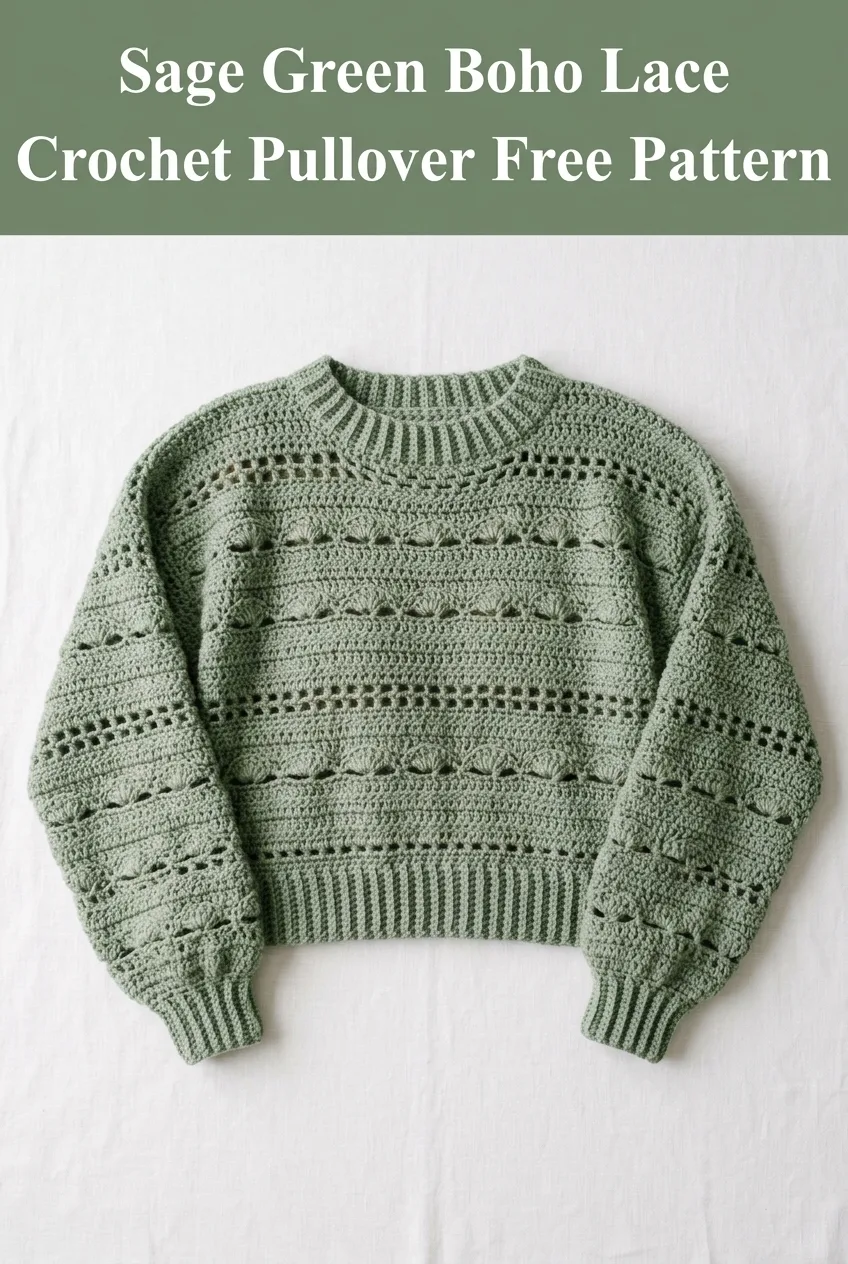
This sage green boho lace crochet pullover combines multiple textures in the most satisfying way. You get the visual interest of openwork lace sections, the tactile dimension of bobble stitches, and the polished finish of ribbed cuffs and hem. It looks complicated, I know. But if you can work basic stitches and follow a repeating pattern, you can absolutely make this sweater.
Why You Will Love This Crochet Pullover Pattern
The Willow Sweater sits right at that sweet spot between casual and elevated. The cropped length pairs perfectly with high-waisted jeans. The slightly oversized fit through the body and sleeves keeps things comfortable without looking sloppy. And that sage green? Chef’s kiss. It works for spring layering, summer evenings, and cozy fall days.
What makes this boho lace crochet sweater pattern special is the construction method. You will work the front and back panels flat, then join them at the shoulders and sides. The sleeves get worked separately and sewn in. Finally, you pick up stitches around the neckline and work that beautiful ribbed collar. This approach keeps things manageable and lets you try on as you go.
The textured stitch pattern repeats consistently across the body and sleeves, so once you get into the rhythm, your hands will know what to do. That is my favorite kind of project. Enough variation to stay interesting, enough repetition to feel meditative.
Materials Needed
Yarn: Approximately 1200 to 1400 yards of worsted weight yarn, depending on your size. Look for a soft cotton blend or a smooth acrylic that has good stitch definition. The sample uses a cotton and acrylic blend in a muted sage green.
Hook: 5.0mm (H/8) crochet hook for the main body. 4.5mm (7) crochet hook for the ribbing sections.
Notions:
Gauge: 16 stitches and 14 rows = 4 inches in the main stitch pattern using the 5.0mm hook. Please check your gauge before starting.
Skill Level
Intermediate. You should be comfortable with basic stitches, working in rows, increasing and decreasing, and seaming pieces together. The lace sections involve skipping stitches and working chains, which creates the openwork effect. The bobbles require working multiple stitches into one stitch, then joining them together.
If you have made a basic sweater or cardigan before, you are ready for this pattern. If this is your first garment, take your time with the swatching process and read through the entire pattern before starting.
Stitch Abbreviations and Definitions
Ch (Chain): Yarn over, pull through the loop on your hook. This creates the foundation and is used for turning and spacing.
Sl st (Slip Stitch): Insert hook, yarn over, pull through both loops. Used for joining and creating a tight, flat stitch.
Sc (Single Crochet): Insert hook, yarn over, pull up a loop (2 loops on hook), yarn over, pull through both loops. Creates a short, dense stitch.
Hdc (Half Double Crochet): Yarn over, insert hook, yarn over, pull up a loop (3 loops on hook), yarn over, pull through all 3 loops. Slightly taller than single crochet.
Dc (Double Crochet): Yarn over, insert hook, yarn over, pull up a loop, yarn over, pull through 2 loops, yarn over, pull through remaining 2 loops. Creates a taller, more open stitch.
Bobble (Bob): Work 5 double crochets into the same stitch, but stop each one before the final yarn over. You will have 6 loops on your hook. Yarn over and pull through all 6 loops at once. This creates a raised, textured bump on the right side of your work.
Sk (Skip): Pass over the indicated stitch without working into it.
BLO (Back Loop Only): Work into only the back loop of the stitch, leaving the front loop unworked. This creates the ribbed texture.
FLO (Front Loop Only): Work into only the front loop of the stitch.
Size Information
This pattern is written for size Small with adjustments for Medium, Large, and Extra Large in parentheses.
Finished Bust Measurement: 38 (42, 46, 50) inches with approximately 4 to 6 inches of positive ease.
Finished Length: 18 (19, 20, 21) inches from shoulder to hem.
Sleeve Length: 18 (18.5, 19, 19.5) inches from underarm to cuff.
The Main Stitch Pattern
Before diving into the full panels, practice this stitch pattern to understand the rhythm. The Willow Sweater uses a repeating sequence that creates horizontal bands of texture.
Foundation: Chain a multiple of 6 plus 3.
Row 1 (Wrong Side): Sc in 2nd ch from hook, sc in each ch across. Turn.
Row 2 (Right Side): Ch 1, sc in each st across. Turn.
Row 3: Ch 3 (counts as dc), dc in each st across. Turn.
Row 4: Ch 3, dc in next st, *ch 1, sk 1, dc in next 2 sts; repeat from * across. Turn. This creates the lace openwork row.
Row 5: Ch 3, dc in each dc and ch-1 space across. Turn.
Row 6: Ch 1, sc in first 3 sts, *bobble in next st, sc in next 5 sts; repeat from * across, ending with sc in last 3 sts. Turn.
Row 7: Ch 1, sc in each st across. Turn.
Row 8: Ch 3, dc in each st across. Turn.
Repeat Rows 2 through 8 for the pattern.
Back Panel Instructions
Using the 5.0mm hook, ch 77 (85, 93, 101).
Foundation Row: Sc in 2nd ch from hook, sc in each ch across. Turn. (76, 84, 92, 100 sts)
Rows 1 through 4: Ch 1, sc in each st across. Turn.
Now begin the main stitch pattern:
Row 5: Ch 3 (counts as dc here and throughout), dc in each st across. Turn. (76, 84, 92, 100 sts)
Row 6: Ch 3, dc in next st, *ch 1, sk 1, dc in next 2 sts; repeat from * across. Turn.
Row 7: Ch 3, dc in each dc and ch-1 space across. Turn. (76, 84, 92, 100 sts)
Row 8: Ch 1, sc in first 3 sts, *bobble in next st, sc in next 5 sts; repeat from * across, adjusting the final repeat as needed to end evenly. Turn.
Row 9: Ch 1, sc in each st across. Turn.
Row 10: Ch 3, dc in each st across. Turn.
Rows 11 through 12: Ch 1, sc in each st across. Turn.
Repeat Rows 5 through 12 until the panel measures approximately 11 (11.5, 12, 12.5) inches from the foundation, ending on a wrong side row.
Armhole Shaping:
Next Row: Sl st in first 5 (6, 7, 8) sts, ch 1, sc in same st, work in pattern across to last 5 (6, 7, 8) sts. Turn, leaving remaining sts unworked. (66, 72, 78, 84 sts)
Continue in pattern for an additional 7 (7.5, 8, 8.5) inches.
Shoulder Shaping:
Work across first 20 (22, 24, 26) sts. Fasten off. Skip center 26 (28, 30, 32) sts for the neck. Rejoin yarn and work across remaining 20 (22, 24, 26) sts. Fasten off.
Front Panel Instructions
Work exactly as the Back Panel through the armhole shaping section.
Continue in pattern until the front measures 5 (5.5, 6, 6.5) inches from armhole bind off.
Neck Shaping:
Work across first 26 (28, 30, 32) sts. Turn, leaving remaining sts unworked.
Next Row: Sl st in first 3 sts, work in pattern to end. Turn.
Next Row: Work in pattern to last 3 sts. Turn.
Continue decreasing 1 st at the neck edge every row 3 more times. (20, 22, 24, 26 sts)
Work even until the front matches the back length to shoulder. Fasten off.
Rejoin yarn to work the second shoulder, reversing all shaping.
Sleeve Instructions (Make 2)
Using the 5.0mm hook, ch 41 (43, 45, 47).
Foundation Row: Sc in 2nd ch from hook, sc in each ch across. Turn. (40, 42, 44, 46 sts)
Rows 1 through 4: Ch 1, sc in each st across. Turn.
Begin the main stitch pattern as established for the body panels.
Increase Row: Work 2 sts in the first st, continue in pattern to last st, work 2 sts in last st. Turn. (42, 44, 46, 48 sts)
Continue in pattern, working an increase row every 6th row a total of 8 (9, 10, 11) times. (56, 60, 64, 68 sts)
Work even until the sleeve measures 16 (16.5, 17, 17.5) inches from foundation.
Sleeve Cap Shaping:
Sl st in first 5 (6, 7, 8) sts, work in pattern to last 5 (6, 7, 8) sts. Turn.
Decrease 1 st at each edge every row 4 times.
Decrease 1 st at each edge every other row until 16 (18, 20, 22) sts remain.
Fasten off.
Ribbed Cuffs
Using the 4.5mm hook, ch 12.
Row 1: Sc in 2nd ch from hook, sc in each ch across. Turn. (11 sts)
Row 2: Ch 1, sc in BLO of each st across. Turn.
Repeat Row 2 until the ribbing measures approximately 7 (7.5, 8, 8.5) inches when slightly stretched.
Sl st the short edges together to form a loop. Whip stitch to the bottom edge of the sleeve.
Ribbed Hem
Using the 4.5mm hook, ch 16.
Row 1: Sc in 2nd ch from hook, sc in each ch across. Turn. (15 sts)
Row 2: Ch 1, sc in BLO of each st across. Turn.
Repeat Row 2 until the ribbing measures approximately 36 (40, 44, 48) inches when slightly stretched.
Sl st the short edges together to form a loop. Whip stitch to the bottom edge of the body, distributing the ribbing evenly around the entire hem.
Neckline Ribbing
Join the front and back panels at the shoulders using a whip stitch or mattress stitch.
Using the 4.5mm hook, join yarn at one shoulder seam.
Round 1: Work approximately 80 (84, 88, 92) sc evenly around the neckline opening. Sl st to first sc to join.
Round 2: Ch 1, sc in BLO of each st around. Sl st to join.
Repeat Round 2 for 8 to 10 rounds, or until the collar reaches your desired height.
Fasten off and weave in ends.
Assembly and Finishing
Step 1: Block all pieces according to your yarn’s care instructions. This helps even out your stitches and makes seaming much easier.
Step 2: Sew the side seams of the body using a whip stitch or mattress stitch, leaving the armhole openings.
Step 3: Set in the sleeves, matching the center of the sleeve cap to the shoulder seam. Pin in place before sewing to ensure even distribution.
Step 4: Weave in all remaining ends. I like to weave along the same color pathway, then double back in the opposite direction for security.
Step 5: Give your finished sweater a final blocking if needed.
Tips for Success
Gauge matters here. A sweater that is off by even one stitch per inch will end up several inches too big or too small. Take the time to swatch and adjust your hook size.
Count your stitches regularly. The lace rows with chain spaces can throw off your stitch count if you are not careful. After each pattern repeat, do a quick count.
Use stitch markers at the beginning and end of each row to help you see where to place your first and last stitches.
Try it on as you go. Once you have the back panel finished, hold it up to yourself in the mirror. You can still adjust the length before starting the front.
Customization Ideas
This crochet pullover pattern adapts beautifully to different looks:
Change the length by adding or removing pattern repeats before the armhole shaping. Want a cropped sweater? Stop sooner. Prefer a tunic length? Keep going.
Adjust the neckline by working fewer or more rounds of ribbing at the collar. A shorter collar gives a crew neck look. A longer collar creates a cozy turtleneck.
Play with color by using a variegated yarn for a different effect, or work the bobble rows in a contrasting shade for more visual pop.
I hope you love making the Willow Sweater as much as I loved designing her. If you give this pattern a try, I would absolutely love to see your finished project. Tag me on Instagram or share it in our Facebook group. Your photos honestly make my whole week.
Save this sage green boho lace crochet pullover pattern to your Pinterest boards so you can find it when you are ready to cast on. And please drop a comment below if you have any questions or just want to say hello. I read every single one.
You Might Also Like
- Lavender Dream Crescent Purse with Silver Accents Free Crochet Pattern
- Dusty Rose Grid Tie Cardigan Free Crochet Pattern
- Blush Pink Seahorse Baby Blanket Free Crochet Pattern
- Sunset Coral Drawstring Bucket Bag Free Crochet Pattern