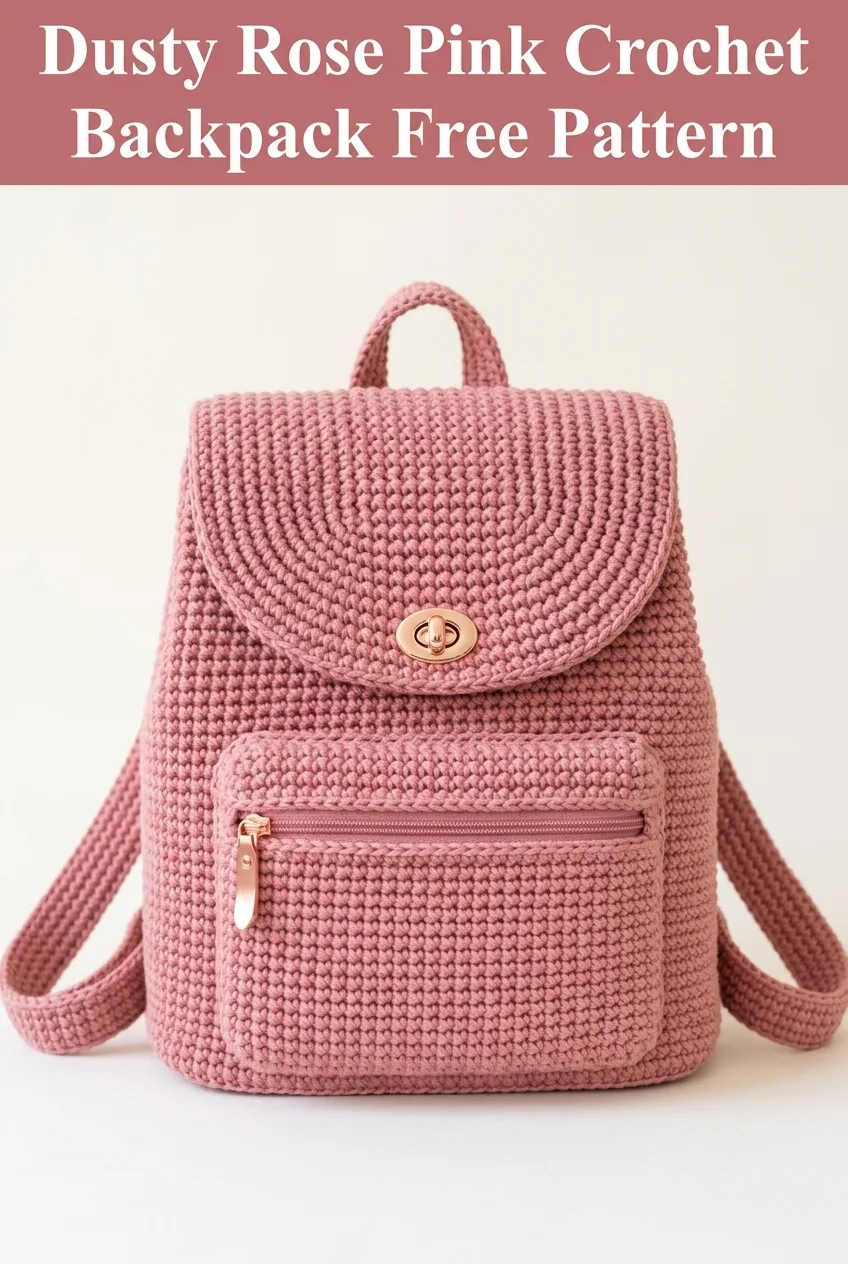
THIS is the project you have been waiting for! If you want something that looks absolutely stunning, works up faster than you would expect, and will have everyone asking "wait, you MADE that?!" then grab your hook right now. This dusty rose crochet backpack is one of my favorite makes ever. It looks like something you would find in a boutique, but you can crochet the whole thing yourself in a weekend. The construction is simpler than it appears, the finished result is incredibly sturdy, and it makes the most impressive handmade gift. Trust me when I say this crochet backpack pattern is going to become your new obsession.
Why You Will Love This Crochet Backpack Pattern
I know what you might be thinking. A whole backpack? With zippers and hardware? That sounds intimidating. But here is the truth: if you can work single crochet in rows and rounds, you can absolutely make this bag. The secret is that we are building simple shapes and then assembling them. No complicated shaping, no confusing decreases, no yarn overs that make you want to throw your hook across the room.
The dusty rose color is everything. It is sophisticated, modern, and goes with practically any outfit. But of course you can make this in any color that speaks to you. Navy would be gorgeous. Mustard yellow? Stunning. Cream for a neutral everyday bag? Perfect.
This crochet tutorial walks you through every single piece, stitch by stitch. By the end, you will have a fully functional backpack with adjustable straps, a front zippered pocket, a flap closure with a twist lock, and a convenient top handle for grabbing on the go.
Materials You Will Need
Yarn: Approximately 400 to 450 grams of worsted weight cotton yarn (Weight 4). Cotton or a cotton blend works best for bags because it holds its shape, does not stretch over time, and creates a sturdy fabric. I recommend a tightly spun yarn rather than something soft and drapey. Look for yarn labeled as "dishcloth cotton" or "kitchen cotton" for the best results.
Hook: 4.0mm (US G/6) crochet hook. You may need to adjust based on your tension. The fabric should be dense with no gaps between stitches.
Hardware:
Notions:
Gauge and Finished Dimensions
Gauge: 18 stitches and 20 rows equals 4 inches in single crochet worked in rows. Please check your gauge before starting. A bag that is too loose will stretch and sag when you use it.
Finished Dimensions: Approximately 10 inches tall, 9 inches wide, and 4 inches deep. Strap length is adjustable, approximately 24 to 32 inches.
Stitch Abbreviations and Definitions
Ch (Chain): Yarn over, pull through the loop on your hook. This creates the foundation for your work.
Sl st (Slip Stitch): Insert hook into stitch, yarn over, pull through both the stitch and the loop on your hook in one motion. Used for joining and creating a flat seam.
Sc (Single Crochet): Insert hook into stitch, yarn over and pull up a loop (2 loops on hook), yarn over and pull through both loops. This creates the dense, sturdy fabric perfect for bags.
Inc (Increase): Work 2 single crochet stitches into the same stitch. This adds one stitch to your total count.
Sc2tog (Single Crochet 2 Together): Insert hook into first stitch, yarn over and pull up a loop, insert hook into next stitch, yarn over and pull up a loop (3 loops on hook), yarn over and pull through all 3 loops. This decreases one stitch.
Step by Step Crochet Backpack Pattern
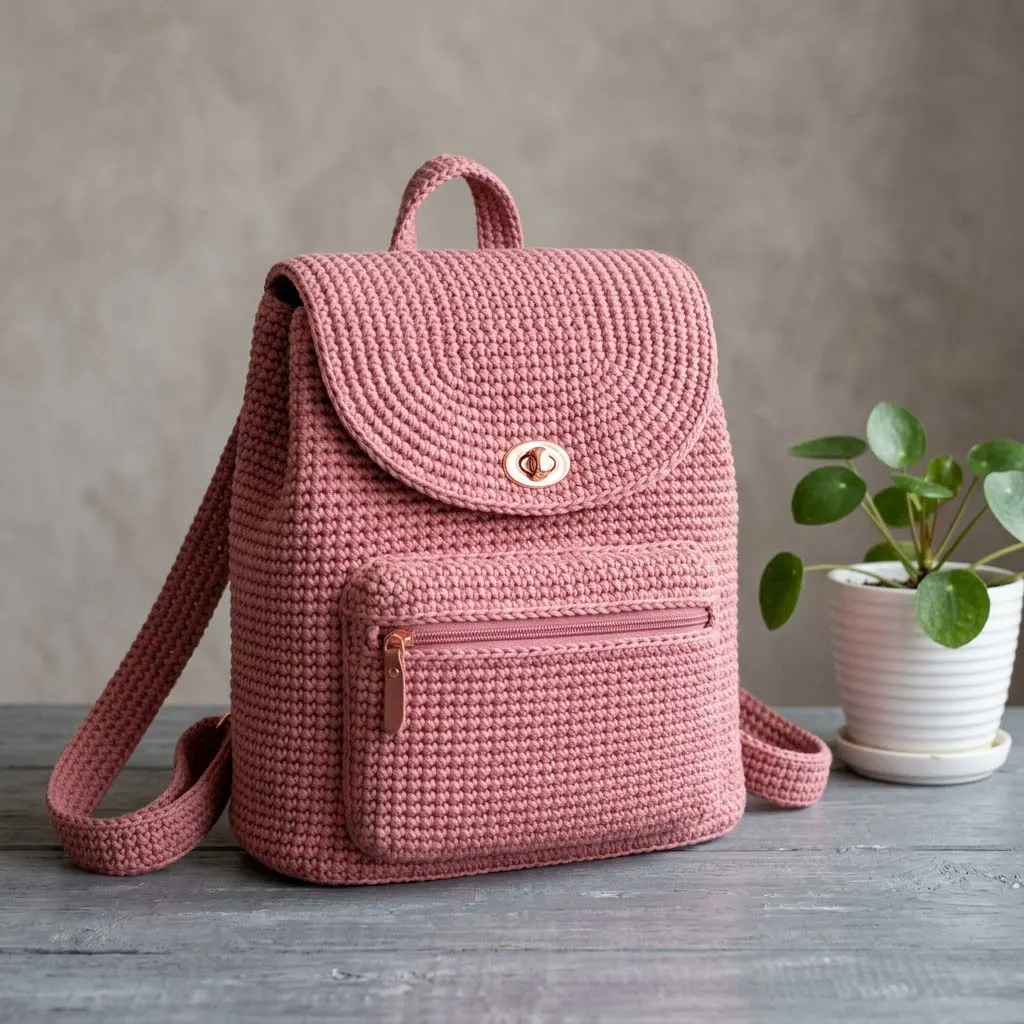
Base of the Backpack
The base is a simple rectangle worked in rows. This creates the bottom of your bag.
Row 1: Ch 19. Sc in 2nd ch from hook and in each ch across. Turn. (18 sts)
Rows 2 through 18: Ch 1, sc in each st across. Turn. (18 sts)
Fasten off and weave in ends. You should have a rectangle measuring approximately 4 inches by 4 inches.
Body of the Backpack
Now we work in continuous rounds around the base to build up the sides of the bag. Place a stitch marker at the beginning of each round and move it up as you go.
Round 1: Join yarn to any corner of the base. Ch 1, work 18 sc across the short edge, 3 sc in corner, 18 sc across the long edge, 3 sc in corner, 18 sc across the short edge, 3 sc in corner, 18 sc across the long edge, 3 sc in corner. Do not join. Work in a continuous spiral. (84 sts)
Round 2: Sc in each st around, working 2 sc in each corner stitch. (88 sts)
Rounds 3 through 5: Sc in each st around. (88 sts)
Now we continue without corner increases to build straight sides.
Rounds 6 through 50: Sc in each st around. (88 sts)
Sl st to next st to join. Fasten off and weave in ends.
Your body should measure approximately 10 inches tall from the base.
Flap
The flap is worked flat and then shaped into a curved bottom edge. This is what folds over the top of your backpack.
Row 1: Ch 37. Sc in 2nd ch from hook and in each ch across. Turn. (36 sts)
Rows 2 through 20: Ch 1, sc in each st across. Turn. (36 sts)
Now we shape the curved bottom edge.
Row 21: Ch 1, sc2tog, sc in each st to last 2 sts, sc2tog. Turn. (34 sts)
Row 22: Ch 1, sc in each st across. Turn. (34 sts)
Row 23: Ch 1, sc2tog, sc in each st to last 2 sts, sc2tog. Turn. (32 sts)
Row 24: Ch 1, sc in each st across. Turn. (32 sts)
Row 25: Ch 1, sc2tog, sc in each st to last 2 sts, sc2tog. Turn. (30 sts)
Row 26: Ch 1, sc2tog, sc in each st to last 2 sts, sc2tog. Turn. (28 sts)
Row 27: Ch 1, sc2tog, sc in each st to last 2 sts, sc2tog. Turn. (26 sts)
Row 28: Ch 1, sc2tog, sc in each st to last 2 sts, sc2tog. Turn. (24 sts)
Row 29: Ch 1, sc2tog, sc in each st to last 2 sts, sc2tog. Turn. (22 sts)
Row 30: Ch 1, sc2tog twice, sc to last 4 sts, sc2tog twice. Turn. (18 sts)
Row 31: Ch 1, sc2tog twice, sc to last 4 sts, sc2tog twice. (14 sts)
Fasten off, leaving a long tail for sewing.
Work one round of sc evenly around the entire flap edge to create a clean finished border. Join with sl st and fasten off.
Front Pocket
This pocket sits on the front of the bag and holds the zipper.
Row 1: Ch 33. Sc in 2nd ch from hook and in each ch across. Turn. (32 sts)
Rows 2 through 20: Ch 1, sc in each st across. Turn. (32 sts)
Fasten off. You should have a rectangle approximately 7 inches wide and 4 inches tall.
For the pocket back panel, repeat the same instructions to create a matching piece.
Top Handle
Row 1: Ch 7. Sc in 2nd ch from hook and in each ch across. Turn. (6 sts)
Rows 2 through 25: Ch 1, sc in each st across. Turn. (6 sts)
Fasten off. Fold the strip in half lengthwise and slip stitch or whip stitch the long edges together to create a tube. This gives the handle more structure and a professional finish.
Shoulder Straps (Make 2)
Row 1: Ch 9. Sc in 2nd ch from hook and in each ch across. Turn. (8 sts)
Rows 2 through 130: Ch 1, sc in each st across. Turn. (8 sts)
Fasten off. This creates a strap approximately 26 inches long. Adjust the number of rows for your preferred length.
Optional: Fold each strap in half lengthwise and whip stitch closed for added durability and a rounder appearance.
Strap Connectors (Make 2)
These small tabs attach to the bottom of the bag and hold the D rings.
Row 1: Ch 5. Sc in 2nd ch from hook and in each ch across. Turn. (4 sts)
Rows 2 through 8: Ch 1, sc in each st across. Turn. (4 sts)
Fasten off. Thread the tab through a D ring, fold in half, and sew the ends together securely.
Assembly Instructions
Take your time with assembly. This is where your backpack really comes together, and careful sewing makes all the difference in the finished look.
Attach the Base
If you worked the body in rounds starting from the base, your base is already attached. If you worked them separately, pin the base to the bottom of the body and whip stitch around all edges using a tapestry needle and matching yarn.
Install the Front Pocket with Zipper
Step 1: Position the zipper between the two pocket panels. The zipper teeth should be visible between the panels.
Step 2: Using a sewing needle and matching thread, hand stitch the zipper tape to the wrong side of each panel along the top edges. Take your time and keep your stitches small and even.
Step 3: Once the zipper is installed, sew the pocket panels together along the sides and bottom, wrong sides facing.
Step 4: Position the completed pocket on the front of the backpack body, approximately 1 inch up from the bottom. Pin in place and whip stitch around the sides and bottom, leaving the top open for access.
Attach the Flap
Position the straight edge of the flap along the back top edge of the backpack body. The flap should fold forward over the front. Pin in place and whip stitch securely.
Install the Twist Lock
Step 1: Mark the center of the curved flap edge, approximately 1 inch up from the bottom curve.
Step 2: Following the hardware manufacturer’s instructions, install the decorative portion of the twist lock on the flap.
Step 3: Close the flap over the front of the bag and mark where the catch portion should go on the bag body.
Step 4: Install the catch portion, making sure the lock aligns properly.
Attach the Top Handle
Position the handle ends on either side of the flap attachment point on the back of the bag. The handle should form a loop at the top. Sew each end securely to the bag body, reinforcing with several passes of yarn.
Attach the Strap Connectors
Sew the strap connector tabs with D rings to the bottom corners of the back of the bag. These should be positioned at the side seams, about 1 inch up from the base.
Attach the Shoulder Straps
Step 1: Sew the top of each strap to the back top corners of the bag, just below where the flap attaches.
Step 2: Thread the bottom of each strap through the D rings at the bottom of the bag.
Step 3: If using adjustable sliders, thread the strap through the slider hardware before attaching to the D ring. This allows you to adjust the length.
Optional Lining
For a more professional finish and to protect the inside of your bag, you can add a fabric lining.
Cut your lining fabric to match the dimensions of the bag body, adding half an inch seam allowance on all sides. Sew the lining into a bag shape. Fold the top edge under and hand stitch the lining inside the crocheted body, just below the top edge.
Helpful Tips for Success
Tension matters. For bags, you want tight, firm stitches. If your fabric feels floppy or you can see through it, go down a hook size.
Block your pieces before assembly. Wet blocking your crocheted panels helps even out stitches and makes sewing much easier.
Use stitch markers generously. Mark your corners, your stitch counts, and any shaping points. You will thank yourself later.
Do not skip the test swatch. I know, I know. Nobody loves making gauge swatches. But spending 15 minutes on a swatch can save you from a bag that is too small or too floppy.
Reinforce stress points. The strap attachments and handle attachment points take a lot of weight and pulling. Sew these areas multiple times with strong stitches.
Customization Ideas
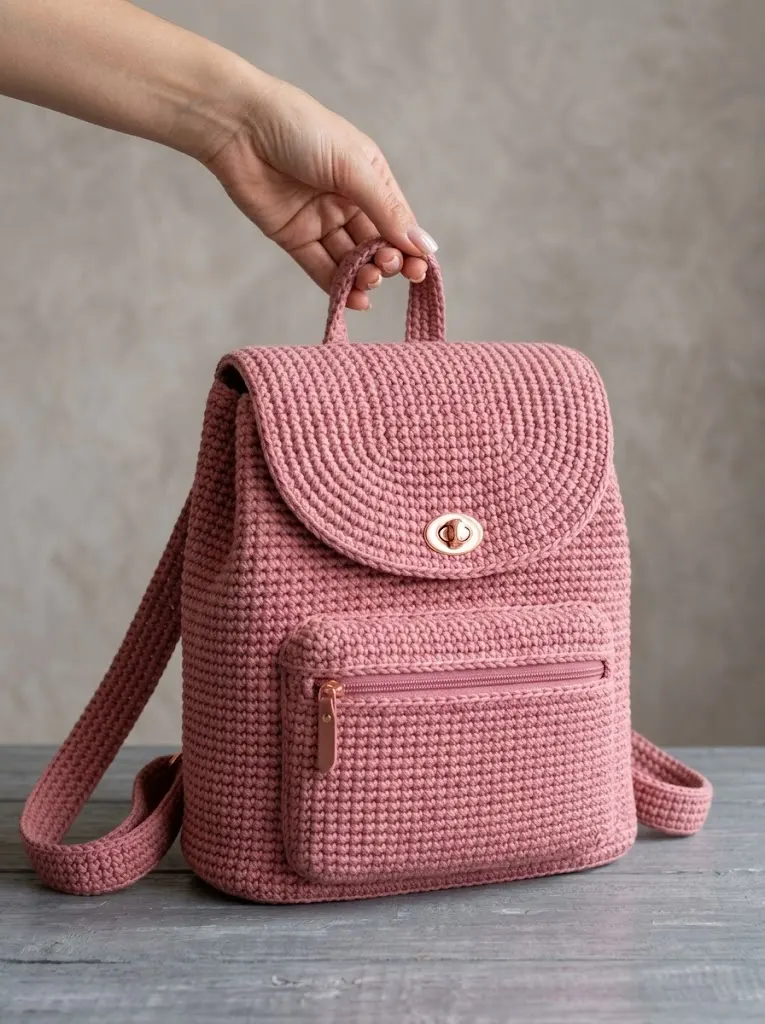
This beginner friendly crochet pattern is easily adapted to your personal style.
Consider adding an internal pocket by sewing a small fabric pouch inside the lining. You can change the flap shape to a pointed or squared design. Try adding decorative stitches, such as a row of puff stitches or a simple texture stripe, around the body for visual interest. Swap the twist lock for a magnetic snap closure for a more casual look.
The straps can also be crocheted wider for more comfort, or you can use leather straps from a craft store for a mixed media look.
I truly hope you love making this dusty rose crochet backpack as much as I loved designing it. It is one of those projects that feels so satisfying to finish, and you will reach for it constantly once it is done.
If you make this crochet backpack pattern, I would absolutely love to see it! Share your finished project with me on Instagram or in our Facebook group. Seeing your creations genuinely makes my day.
Do not forget to save this pattern to your Pinterest boards so you can find it easily when you are ready to start. And if you make this backpack, please leave a comment below! I love hearing which colors you chose, how the construction went for you, and any tips you discovered along the way. Happy crocheting, friend!
You Might Also Like
- Dusty Rose Grid Tie Cardigan Free Crochet Pattern
- Mint Green Summer Baby Romper Free Crochet Pattern
- Black Fishnet Crochet Bell Sleeve Shrug Free Pattern
- Ocean Blue Boho Crochet Gladiator Sandals Free Pattern